

qualifying export credit
at the gazetted domestic energy rate
Sabah · Sabah Electricity
Use solar first, receive programme credit for eligible surplus and add a correctly designed battery system for selected essential loads during an outage.
Solar Rakyat Sabah
1-for-1export credit at the gazetted domestic energy rateSubject to programme eligibility, approval and availability.At a glance · reviewed 19 July 2026
Under Solar Rakyat Sabah, eligible domestic customers can self-consume rooftop solar and receive bill credit for qualifying surplus exports at the prevailing gazetted domestic energy rate. Published caps are 5 kWac for single-phase and 10 kWac for three-phase homes, with a 12-year contract. The 20 MW quota is first-come, first-served until 30 June 2028 or full subscription. Battery storage is allowed for self-consumption, but stored energy cannot be exported for programme credit.
at the gazetted domestic energy rate
first-come, first-served
subject to assessment
under official programme terms













Media coverage does not imply endorsement. Client and collaboration logos are selected from the wider Progressture Solar project portfolio and do not imply that every relationship was residential.
 Hornbill policy guide · Sabah
Solar Rakyat Sabah explained
Your home consumes solar as it is generated. A bidirectional smart meter measures imports and eligible exports, while unused export credits can roll forward for up to 12 months under programme rules.
Generation first reduces electricity imported from Sabah Electricity.
Imports and eligible surplus exports are measured separately for billing.
Approved exports receive credit at the prevailing gazetted domestic energy rate.
Programme credit may carry for up to 12 months before it expires; it is not paid as cash.
What changes the economics
Headline incentives are useful, but your net investment, self-consumption and approved design determine the real return.
Domestic homes can apply through EEISy using an ECoS-registered solar contractor, subject to assessment.
The contract creates a clear period for eligible solar-export credit, while self-consumption starts from day one.
Storage can protect selected loads, but battery energy is for self-use and cannot be exported for Solar Rakyat credit.
Solar Rakyat energy flow
During the day, solar lowers grid purchases and eligible surplus can earn programme credit. An optional battery sits behind the meter to increase self-use or support backup—it does not create export credit.
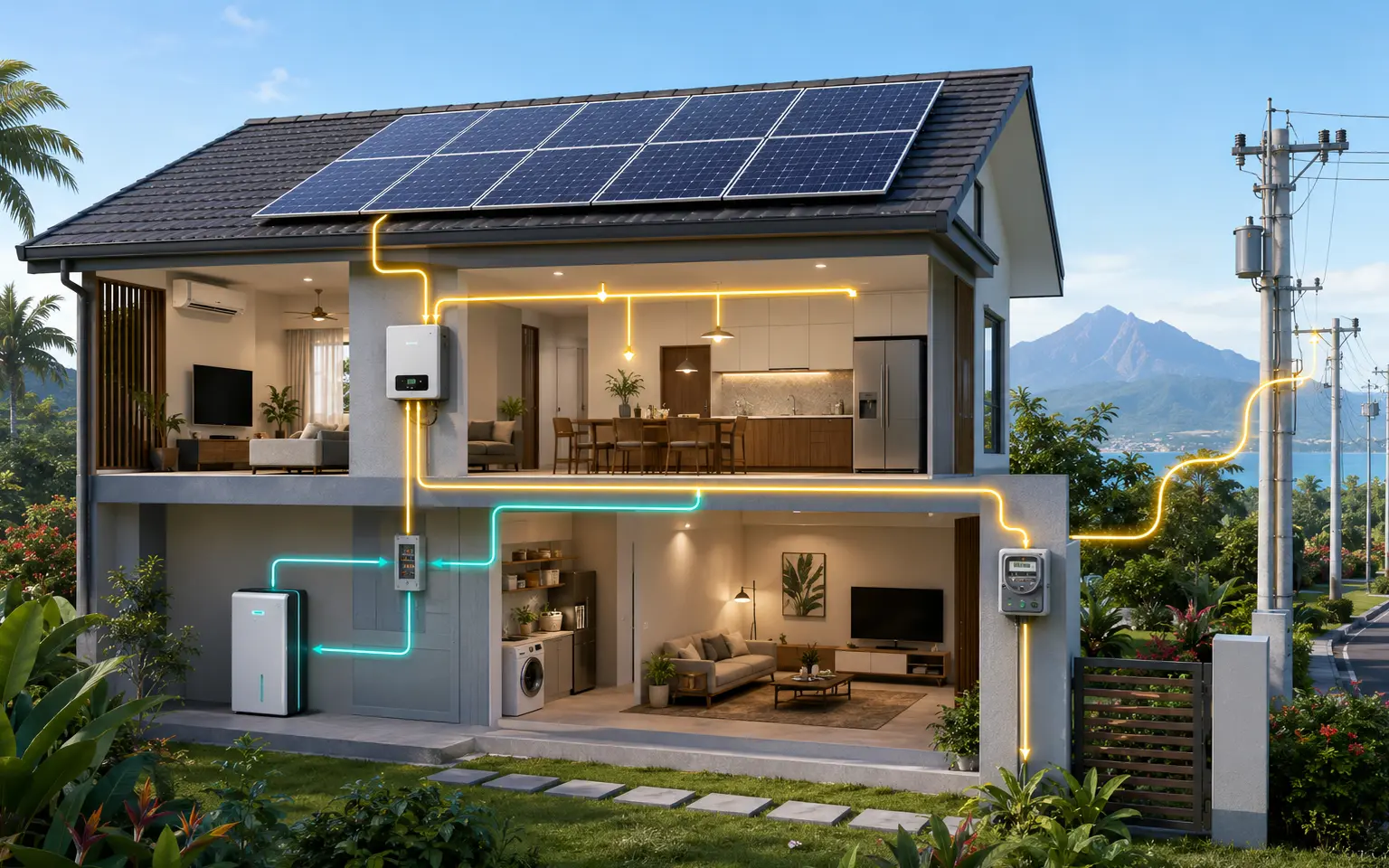 Illustrated guide · Solar Rakyat Sabah
Active household loads take priority whenever the roof is generating.
The bidirectional smart meter records qualifying solar exported under Solar Rakyat.
Sabah Electricity supplies the home when demand exceeds solar generation.
Stored energy can serve the home or backup circuit, but it cannot be exported for programme credit.
Illustrative flow only. Battery operation, export control and backup capability depend on the approved design, inverter, battery and programme rules.
A practical first check
We use your bill, roof and priorities to answer this before asking you to choose a package.
Check my home →Eligibility starting point
This checklist is an initial guide. Final eligibility is determined under the official programme and utility assessment.
What Hornbill handles
The single- or three-phase supply determines the maximum programme capacity.
We model bill savings first, then identify essential loads and battery runtime if resilience is needed.
Hornbill coordinates the assessment and application workflow as the registered contractor.
After approval, the system is installed, tested and handed over with clear operating guidance.
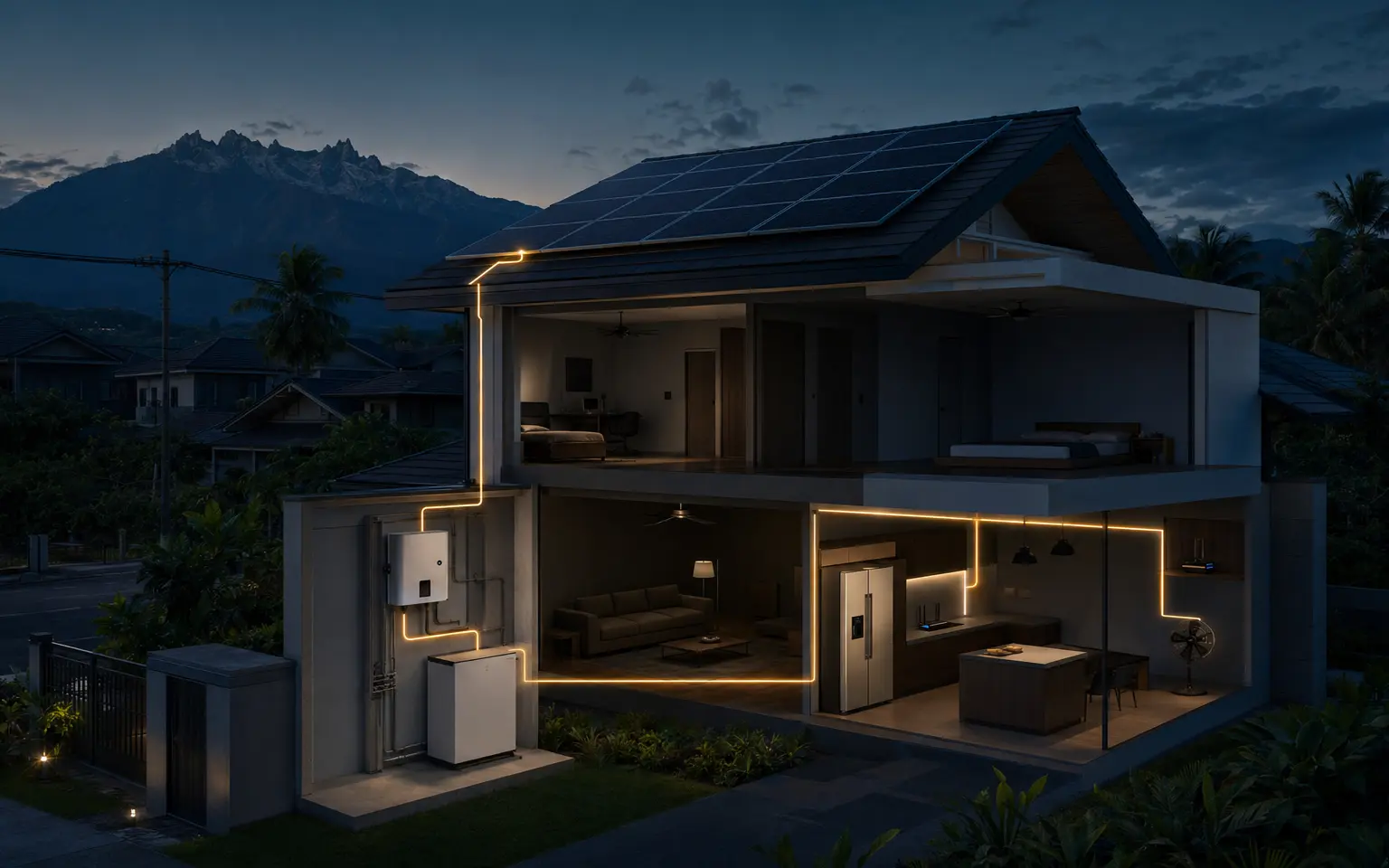
Sabah outage resilience
Sabah has experienced scheduled load rationing and supply interruptions. Rooftop solar is valuable, but a normal grid-tied inverter must shut down during an outage. Continuity comes from a purpose-designed hybrid inverter, battery and protected backup circuit.
The backup system disconnects from the utility grid so it cannot energise external lines during an outage.
Lighting, Wi-Fi, security, fans, refrigeration or other agreed essentials can be placed on a dedicated backup circuit.
A compatible hybrid inverter can move supported loads to battery supply quickly; exact switching performance depends on the selected model and wiring.
Some compatible systems can form a local supply and restart without the grid. We confirm this against the exact inverter, battery, firmware and site configuration before promising it.
Backup is not automatically whole-home power. Runtime depends on battery state of charge, usable capacity and connected load. Under Solar Rakyat Sabah, stored battery energy must remain for self-consumption and cannot be exported for programme credit.
It is Sabah’s residential rooftop solar programme. Eligible domestic customers can self-consume solar and receive bill credit for qualifying surplus exports under a 12-year agreement, subject to the 20 MW quota and programme approval.
Qualifying solar energy exported to the grid is credited at the prevailing gazetted domestic energy rate used by the programme. Unused credit can roll forward for up to 12 months but is not paid out as cash.
The published caps are 5 kWac for a single-phase supply and 10 kWac for a three-phase supply, subject to technical assessment and approval.
ECoS states that a complete application is expected to receive an outcome within 14 working days. Missing information, technical issues or quota status can affect the actual timeline.
Usually no. A standard grid-connected inverter shuts down for anti-islanding safety. Backup requires a compatible hybrid inverter, battery, correct protection and an isolated backup or EPS circuit.
It means a compatible system can establish a safe local electricity supply after the grid is absent, without relying on the grid to start. Capability varies by inverter, battery, firmware and wiring, so it must be confirmed for the quoted system.
No. The programme states that stored energy is for self-consumption and cannot be exported for Solar Rakyat credit. The battery’s value is therefore resilience and increased self-use, not export income.
A clear answer, before any commitment
We'll estimate the right system size, likely savings, applicable incentive, simple payback and next steps for Sabah.